Ahead of the Curve: Two Years at Harvard Business School

Ahead of the Curve: Two Years at Harvard Business School Ahead of the Curve: Two Years at Harvard Business School by Philip Delves Broughton

My review


rating: 3 of 5 stars
For the first ~270 pages Phillip Delves Broughton does a very good job of reporting what happens on the prestigious HBS campus. He chronicles the classes, the case studies, the students, the teachers, and the job hunt in a manner that helps you feel like you were there.

However, his last 10 pages devolve into a preachy chorus of all that is wrong with HBS, all that is wrong with business in general, and why he is above it all. He implies that if you care about your family, then you can’t go into business. And if you go into business then you must not care about your family. Definitely BS in my opinion.

Bottom line, if you have any interest in understanding what business school is all about, then I recommend reading the book. Just make sure to come to your own opinions about the merits of a career in business.

View all my reviews.

Ahead of the Curve: Two Years at Harvard Business School

Embedding Flickr Slideshows!

I know that this functionality is nothing new. Companies like Slide have been enabling people to create slideshows and embed them in their blogs for a long time. But all my photos are in Flickr and so it’s awesome that I can now do this directly from Flickr without the help of any third-party intermediary.

To show off the new stuff, here’s a slideshow of a recent trip to Bali, Indonesia. If you’ve never been before, put it high on your to do list. I promise that you won’t regret it.


Embedding Flickr Slideshows!

3G iPhone…t minus 3 days

For those of you all that read this blog regularly (yes, I realize that that is probably no one, but I can dream!), you know that I’ve been waiting for the release of the 3G iPhone for quite some time.

Well, it’s nearly here and Walt Mossberg has come out with his official review. Nothing surprising really. He lauds both the 3G data speeds and GPS, but also knocks it for potential battery life issues and the fact that you’ll now pay more over the 2 year contract (since AT&T has raised the price for unlimited data plan to offset the lower upfront price).

Bottom line…nothing in there that will stop me from buying it come Friday!

Here’s his video review if you are interested in hearing firsthand….

3G iPhone…t minus 3 days

Celtics vs. Lakers…it’s fannnntastic!

Incredible. As Dan Wetzel writes, no one was expecting this to happen 12 months ago. Kobe wanted to be traded, and the Celtics – seemingly forever cursed in the lottery draft (see Len Bias and the 1997 lottery) – once again were unlucky with the ping pong balls.

But it happened. Kobe stayed in LA and they later picked up Paul Gasol. The Celtics somehow managed to pick up both Kevin Garnett and Ray Allen. And now we have the two most storied franchises in basketball back in the finals together for the first time since 1987.

Since the peak in 1998 for Jordan’s last championship, the NBA Finals Nielsen ratings have been in decline. But something tells me that this series might just beat out last year’s pathetic showing for the Spurs vs. Cavaliers Finals. If a return to the Lakers and Celtics in the finals together doesn’t do it, then nothing will.

Celtics vs. Lakers…it’s fannnntastic!

Time to sell GOOG?

There is an interesting theory out there saying that Harvard grads (and in particular HBS grads) collectively serve as a good leading indicator of where the US equity market is going. In a nutshell, the theory goes that if lots of HBS grads are headed to Wall St., then the markets are overvalued and headed south. Conversely, if fewer HBS grads are going into the world of high finance, then the markets have goodness in store for all of us. Basically, HBS students don’t like to show up to the party until everyone else has already arrived, and more often than not, they arrive just as everyone else has decided to leave and go home.

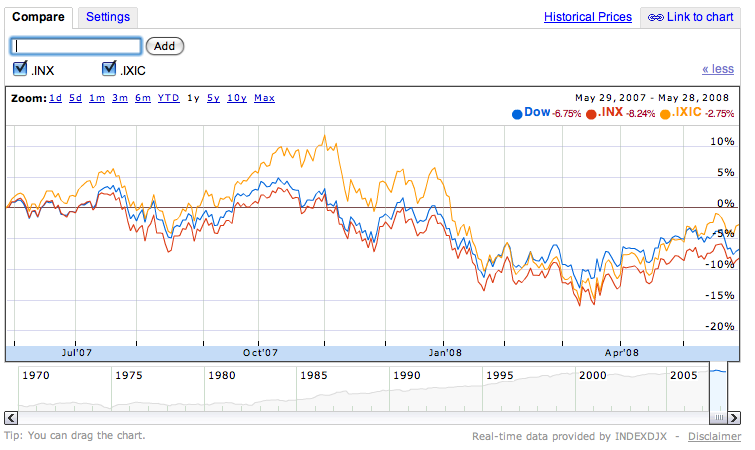
As for the 2007 HBS graduating class, it appears that 40% are headed for “market sensitive” careers, up from 37% in 2006 and 30% in 2005. So if you believe the theory, then you better be selling! Or rather you better have been selling already because as you see in the graph below, all of the major indices are down in the last 12 months (i.e., basically since the time the 2007 class graduated).


But enough with the intro. On to my point. Fortune magazine just came out with its annual list of the top 100 most desirable MBA employers. And while it doesn’t allow you to break out the list to just HBS grads, let’s assume for a moment that all MBA grads – not just the poor folks at HBS – are bad at picking their career paths. If the theory works for all MBA students, then perhaps this list enables you to infer not only which way the stock market as a whole is headed, but also where specific companies are headed?

Who’s at the top of the list for the class of 2008? Google. Does this mean GOOG is ready for a fall? Well, they were #2 in 2006 and the stock rocketed upwards during the year that followed that class’s graduation. By 2007 they had got the #1 spot, but the stock is still slightly up since the 2007 MBA grads joined the workforce.

Could this finally be the year the theory works and GOOG drops? Should we sell? Should we sell AAPL (#4 on the 2008 list)?

My own hypothesis: the theory might work fairly well when guessing the direction of the market as a whole, but it will break down and have less success when applied to individual companies. Get a big enough sample size and you will be okay. Focus in on a single data point (or company) and there are too many external factors that could change the outcome. In statistical terms, pick a single point in a normal distribution and you may be well off the mean. But take the full sample and you’ll zero right in on the mean.

Or perhaps the MBA grads are not as quite as useless as every engineer in the valley suspects!

Time to sell GOOG?

Twitter: just a dumb pipe?

So I’ve been experimenting with Twitter a bit more over the last month – not a obscene amount like a number of tech geeks out there (I’ve posted only 7 times since Mar. 30), but definitely a ramp in usage for me (during the 10 months prior I posted only 4 times).

In any event, my experimentation has lead me to come to two conclusions:

Observation #1:

People are no longer using Twitter just for broadcasting “what they are doing” despite what Twitter’s home page says. To prove my hypothesis I looked at the most recent 20 “tweets” from the people that I follow (this is what the home page displays by default) and classified them into the three primary use buckets that I’ve observed: (1) status message (i.e., the original use case for Twitter), (2) 1-to-1 messages, and (3) random thought/linkblog/microblog (i.e., everything else that is not a 1-1 message or a “what you are doing” status update). The end result was:
– 40% status messages
– 10% 1-to-1 messages
– 50% random thought/linkblog/microblog

Obviously this is a small sample set, and one that is heavily skewed to the heavy Twitter users that I follow. Nonetheless, it gives some sense for how people are using it. Interestingly, if I look at the last 20 tweets from everyone (not just the people I follow):
– 60% are unknown (i.e., I don’t know because they are not in English)
– 5% are status messages
– 5% are 1-to-1 messages
– 30% are random thought/linkblog/microblog

What does this all mean? It means that Twitter is evolving from a single type of communication into a mode of communication. If you are Twitter, this is all very good news. Their addressable market is expanding.

Observation #2:

Twitter is becoming a dumb pipe. Both on the authoring and receiving ends, it seems that many people are using end points other than Twitter.com (see here and here and here). Once again looking at the last 20 tweets from my friends, I see the following distribution of “authoring” end points:
– 35% twitter.com
– 30% twhirl
– 20% blog it (facebook app)
– 10% text/mobile
– 5% twinkle

Of course, using a limited sample data set from my friends only is even more problematic in this context as compared to the “message type” context described in observation #1. In this context, there are many more end point options than message types, and as such you need a much larger data set to make meaningful conclusions about which are most used. That being said, the last 20 tweets from everyone (not just my friends) indicated a similar pattern (i.e., only 45% of tweets were made via the web on Twitter.com). So while I’m very likely way off on the popularity of the various third party applications vs. each other, I’m probably not that far off on the popularity of Twitter.com vs. all of the third party applications combined.

And what does this mean? Not good for Twitter. Over time I will not be surprised to see some of the end points generate more value than Twitter the company. The end point is where users interact with the service. That is where companies can serve ads, bundle toolbars, include search boxes, etc. There is no doubt that opening up the network to third party developers was a huge driver of growth for Twitter the network. But if Twitter doesn’t invest in their own front end applications they might find it very difficult to ever generate significant value for themselves in the future.

Jon Postel may have been the driving force behind the SMTP standard, but he never achieved the same commercial success of Microsoft Exchange, Yahoo! Mail, Hotmail, or even Gmail. Developing a standard can generate lots of value for users and developers across the Internet, but it’s not necessarily a good recipe for commercial success.

Twitter: just a dumb pipe?

Friday Night Lights: if you aren’t watching, it’s time to start

Slate just came out with a post calling Friday Night Lights the best show on television and I could not agree any more. For a long time now I’ve been telling pretty much anyone that would listen that this the case. The writing, the acting, the storylines, the complexity…unlike most of the rest of television (see Deal or No Deal) these elements are both intelligent and entertaining on FNL.

I wrote about it once already here after buying the first season DVD. At that time I didn’t know if it would live up to my high expectations, but I can now definitively confirm that it did indeed (and then some).

If you don’t want to buy the DVD, no worries. You can catch full episodes from both season 1 and 2 on Hulu for free.

And the best news of all? The Dillon Panthers will be coming back for a third season. Please watch it so I can be saying the same thing again a year from now about season 4.

Friday Night Lights: if you aren’t watching, it’s time to start

Waiting for the 3G iPhone

I got my first taste of 3G mobile browsing over a year ago when I bought the RAZR v3xx and I absolutely loved it. Combining 3G with an unlimited data plan ($20 per month on AT&T) changes your life. Pages load in a snap, and all of a sudden using a WAP browser is actually enjoyable – so enjoyable that I found myself going to WAP sites (e.g., Yahoo! Mail) even when java client versions of the product existed (e.g., Yahoo! Go). The ESPN WAP site is also particularly good if you are constantly checking sports scores like me.

Anyways, my phone died over a month ago and ever since I’ve been falling back on an old RAZR v3 that was collecting dust. In a few words, it’s been brutal. It’s so f’ing slow, which basically makes it unusable. Luckily I also have a corporate Blackberry I can use to connect to the web when on the go, but I don’t bring this phone with me all the time. This means that there are now lots of times that I have no access to the internet, a predicament that wouldn’t be a big deal for some people (e.g., my mom and dad), but is a major problem for a hyper-connected geek like me.

I thought about getting the iPhone right away after my v3xx died, but with all the rumors of a 3G iPhone on the way soon I decided to tough it out until June. Why get a device with such great Internet browsing capabilities (i.e., the large screen and the Safari browser) if you can’t surf on the 3G network, and you’d also find yourself coveting the new iPhone just a few months later?

Thankfully June is approaching quickly. And now there is more news about the impending iPhone reported first on Times Online, and later referenced by Silicon Alley Insider. The speculation this time around is about a “radically different” appearance (e.g., a flip phone version or one with a real QWERTY keyboard). It seems strange to think about an iPhone that doesn’t look like the iconic version we are all used to. Of course if they do come out with something radically different, something tells me that Apple will nail it – just like they did when they came out with each subsequent version of the iPod.

June can’t come soon enough.

Waiting for the 3G iPhone